Ten Steps Back
First published in the print column, The Nature of Things
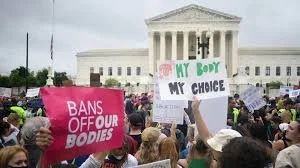
Boy we’ve sure come a long way in our journey for democracy and Americans’ Constitutional rights, with liberty and justice for all—or so it seemed, until recently, when 5 Supreme Court justices sent us reeling, ass over teakettle, back into the dark ages of back alleys and black market operations with coat hangers and crochet hooks. Some may call that an extreme and over-simplified way to look at the reversal of Roe v Wade, but it’s no more extreme or over-simplified than the justifications for the overturn.
The first clause in the Bill of Rights states that “Congress shall make no law respecting an establishment of religion.” That is the part that initially established a clear division of matters regarding church and issues relevant to state. Thomas Jefferson, in his 1802 letter to the Danbury Baptist Association, further clarified its meaning when he declared that when the American people adopted the establishment clause they built a “wall of separation between the church and state.”
But on June 24th, 2022, many foundational blocks of that wall were effectively knocked out and smashed at our feet, right before our eyes. And even worse than that actual fact, is the ignorance of so many people flying the flag of Pro-life, who don’t realize the sweeping scope of the precedence being set by their “win” that threatens basic human rights and freedoms for everyone, and not just on the issue of abortion.
If you are one of the many that opted not to get vaccinated for Covid-19, you may want to brace yourself—your right to make that choice in the future may well be over. This reversal is not the voice of our noble justices rallying in support of the rights of the unborn, so much as it’s a very clear-cut, "F-you if you think you can make decisions for yourself without our consent.”
Here’s the importance of keeping states removed from decisions supported with religious underpinnings: While some are celebrating the strike-down of Roe v. Wade as a win for religious freedom, other religious groups say prohibitions on abortion violate their religious beliefs.
Interpretations vary across Judaism, but some religious Jews believe that a fetus is part of the parent's body and that a baby is only considered a person once it takes its first breath. According to the Women's Rabbinic Network, some of the most sacred text—the Torah, the Mishnah and the Talmud—view a fetus as a soul only once it’s born. Therefore, forcing someone to carry a pregnancy that they do not want or that endangers their life is a violation of Jewish law because it prioritizes a fetus over the living adult who is pregnant.
“This must be understood as a violation of the United States Constitution which guarantees our freedom to practice our religion, and also our freedom from the dictates of other religions,”a spokesperson for the group stated.
I imagine we’ll all be very busy for a long time to come, as all this gets re-hashed and strung out and the usual money mongers jockey into positions to profit. Already criminal defense lawyers are sounding the alarm about mass incarcerations for women and doctors who don’t fall into proper submission and obey. And states that do support legalized abortion are gearing up for an influx of new business.
What a sad mess we’ve made of things.
In other news, I was quite intrigued to learn of a particular book entitled, The Instructor, written by a man named George Fisher. Published in the mid-18th century, this book was a popular household manual with advice and instruction on a wide variety of topics useful to colonial life such as basic arithmetic, recipes, horse-shoeing techniques, as well as an entire section devoted to home remedies for common ailments such as fever, gout, and, oh yeah…. unwanted pregnancy.
The book lists all of the best-known herbal abortifacients and contraceptives of the time, prescribing the use of what your average 18th-century herbalist would have given a woman who wanted to end a pregnancy early.
The popularity and success of this book in its time flies in the face of the Supreme Court opinion that “a right to abortion is not deeply rooted in the nation’s histories and traditions.”
Abortion was not just legal—it was a safe, condoned, and practiced procedure in colonial America, and common enough to appear in the legal and medical records of the period. If a woman living in New England in the 17th or 18th centuries wanted an abortion, no legal, social, or religious force tried to stop her.
If you’re questioning the ethics and morality of the author, and think the founding fathers were all God-fearing men bent on forming a new nation with a Christian worldview, it may help put things in proper perspective to learn that George Fisher was actually a pseudonym used by Benjamin Franklin. He’s the one who actually authored the text.
Abortion and contraception are not new. They are not a product of modernity or rising secularism or a reflection of the downfall of the traditional family. Pro-life advocates (the majority of whom also believe in and support the right to bear arms and the death penalty, both of which legalize killing) have women that are in favor of reproductive rights lumped into this category of irresponsible, promiscuous jezebels who use abortion as a form of birth control, conveying the archaic message: women can’t be trusted to make decisions about their own health and welfare or that of their offspring, the government needs to control that.
Where ever the abortion argument takes you on grounds of morality—the exact time a fetus becomes a person, the spiritual implications of terminating a pregnancy—is a discussion that should be saved for the pulpit, not taken to the courtroom.